The Hidden Power of Playing Side-by-Side
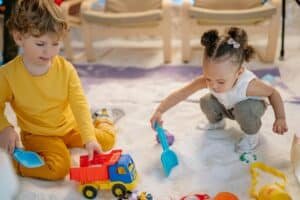
Bringing a toddler to a playdate with another toddler is always an interesting experience. The parents think they’re about to start a sweet friendship for their little one–the pretend kitchen is ready, all of the play food and dishes are prepped, and everyone is ready to watch some imaginative play in action. Only, the toddlers not only do not play together, they play with the same toys, in the play kitchen, with little to no interaction. That is, until someone has the toy they wanted. It may very well be the start of a sweet friendship; it just doesn’t look like what the parents imagined it would…yet. While it may be odd to witness play take shape in this way, it is actually completely developmentally appropriate and lays the foundation for important social and cognitive skills. This is a stage of play referred to as, parallel play.
According to Mildred Parten Newhal’s Six Stages of Play, parallel play is the fourth stage of social play development and is essential for developing cooperation, empathy, and communication skills. During the parallel play stage, which typically takes place when a child is between 2-3 years old, children play next to one another, rather than with and potentially do not directly engaging with each other. During this stage children will often observe and mimic what they have seen in their peers and environment. This is a distinct piece of a child’s early childhood education and spurs them on to grow in a number of ways–socially, emotionally, cognitively, creatively…the list continues. Mind blowing that all of this learning happens simply through play!
According to Harvard’s Center on the Developing Child, back-and-forth interactions—even nonverbal ones seen in parallel play—are critical to brain development during the early years. With this being said, let’s take a deeper look at the benefits of parallel play as well as some ways parents, caregivers, and early childhood educators might set up or help encourage a successful playtime experience.
Here at Chester Child Development Center we love to see this learning in action–watching children grow from babies to young toddlers and into little friends is such an amazing phenomenon to behold! Come for a visit today to see some of this play take place and ask how we encourage developmentally appropriate play for all ages.
The Various Benefits of Parallel Play:
1. Provides a Safe Way to Build Social Awareness
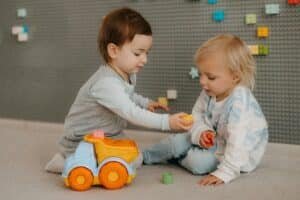
Parallel play gives children a low-pressure opportunity to observe the behaviors of their peers. In playing next to each other, children–being the sponges for learning that they are–can pick up on alternative ways to play, social cues, and boundaries (Source). This gently introduces social dynamics and cultivates a social awareness that is the stepping-stone to group play and sharing.
Providing a safe space to learn and play and grow is essential for little learners within early childhood education. We take this seriously here at Chester CDC and intentionally strive to provide such an environment for all. Schedule a tour and let’s chat about how we can support your little one as they learn and grow.
2. Supports Language and Emotional Development
While there may not be a whole lot of chatter between the children playing at this stage, they do often narrate their play out loud. They hear and learn knew words and ideas as well as pick up on the emotional cues of others–like laughter, frustration, disappointment and excitement. Listening to the self-talk and play of their peers supports early language and social development. They are also provided with the ever-present opportunity to share and assert their own feelings, in doing so building their ability to express themselves verbally. Even with the hallmark statement of toddler-dom “MINE!” (Source).
Language and social development are essential for preschoolers and often starts small–as children begin with first words and picking up on the interactions of the people in their life. At Chester CDC we not only set excellent examples with our early childhood education teachers, but we are also ready to patiently teach and mediate between students to support healthy relationships. Come for a tour, today, and see our teachers in action!
3. Encourages Independence and Confidence
Whether in a daycare or childcare setting, at a friend’s house, or playing at home with siblings, parallel play encourages toddlers to explore social boundaries and interactions at their own pace. This offers them the practice to build up the confidence and sense of independence needed to engage in cooperative play down the road. Additionally, parallel play allows children the space to express autonomy and choose their own play without relying on the constant stimulation and input of others (Source).
Play is happening everywhere here at Chester Child Development Center! Call today to schedule a tour and see our classrooms, various centers and play areas, and outdoor spaces and playgrounds–all places where learning through play thrives!
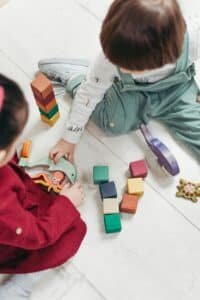 Supporting Parallel Play
- Provide Duplicates: Give each child their own set of blocks, cars, dolls, etc. to reduce conflict and encourage focus.
- Create Shared Space: Create a simple play area that allows children to have their own space for individual exploration but still see and hear each other.
- Provide Options: Encourage creativity with providing a couple of different types of toys to choose from–but not too many! Too many toys will give toddlers little opportunity to play alongside one another and can even be overwhelming.
- Be a Model: Play similarly next to your toddler–narrating as you go. Point out the things you see your little one doing, as well, as a model for interacting with others. “I see you made a big block tower!”
Call today and let’s chat about how we encourage children to play and learn through the different stage of play here at Chester Child Development Center!
Side-by-Side Play to Side-by-Friends
Parallel play is more than just a phase—it’s part of the building blocks that make up meaningful relationships and group learning experiences! As odd as it might be to witness, the next time you see two toddlers playing side-by-side, know that beneath the surface of parallel play is an abundance of learning is taking place. These little ones are learning to be a part of community–one baby doll, crayon, and block at a time.
Ready to introduce your little one to a slew of new friends to learn and grow with? Come see us here at Chester Child Development Center–where we play to learn and build friendships that can last a lifetime!